What the maker’s page says
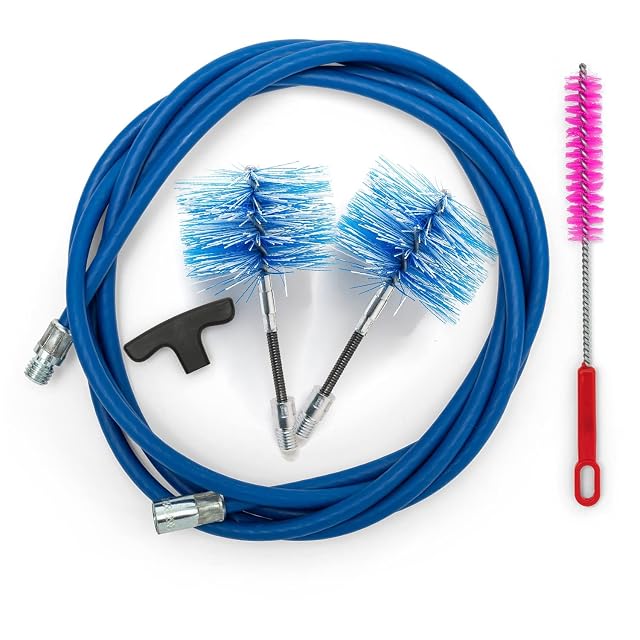
An improved brush head of aluminum alloy, stated to be built for durability, with
strong nylon bristles and a sharp rectangular form allowing thorough cleaning while
preserving the integrity of the chimney surface without scratches. The 10 m (33 ft) nylon
rod is stated to be made of durable, high-strength fibers offering maximum
flexibility, bendable through 90° and robust enough not to break or snag. A rotating
plastic connector is stated to avoid direct contact with the rod for greater safety,
with cleaning from bottom to top removing creosote and dirt, improving efficiency,
reducing fuel consumption and lowering fire risk. A spring-button locking system is
stated to allow effortless connection and disconnection, holding the rod firmly
whichever way it is turned so that it does not come loose during cleaning. The
length is stated to be adjustable with additional rods.
A rectangle in a rectangle
Most chimney sets have a round brush. Masonry flues are frequently not
round.
A circular brush in a square flue touches the middle of each wall and nothing else.
The four corners — which is where soot accumulates, because that is where the gas
moves slowest — are never reached.
The traditional workaround is a spring-steel head trimmed to shape with pincers.
This set skips it and supplies the shape.
For a rendered brick flue or an older square liner, that is the argument.
The swivel
A rotating connector between the rod and the head.
Turning a brush inside a flue without one winds tension into ten meters of rod, and
that tension lets go all at once when the brush frees itself — usually with somebody
holding the bottom end.
A swivel lets the head turn while the rod stays still. It also means a screwed joint
cannot be unscrewed by the rotation, which is the failure a button lock solves from
the other direction.
Spring buttons, holding regardless of rotation.
That is a genuine advantage on a rod that has to be worked back and forth to free a
stuck brush — a threaded joint will unscrew if turned the wrong way, and a brush
left in a flue with the rods retrieved is somebody’s afternoon.
The cost is that this set does not join to anything else. M12 is the common thread
on rod sets. This one is its own system.
Bottom to top
Stated as the method, and it is why rod sets exist at all.
Sweeping from below means working at the fireplace with the flue above, with no
ladder and no roof. The alternative — a weighted rope from the top — is the other
tradition.
What comes down, in either method, comes down onto whoever is underneath.
The head dimensions.
On a set whose distinguishing feature is its shape, how wide and how deep the
rectangle is would decide which flues it suits. It is not on the listing.
Availability
On September 22, 2026, the price sat around $47 at the American Amazon store.
Keepa reading of September 22, 2026; stock and prices change without warning.
Prices quoted in this text are dated readings and can differ from the live price at the top of the page.